
Square Footage Calculator
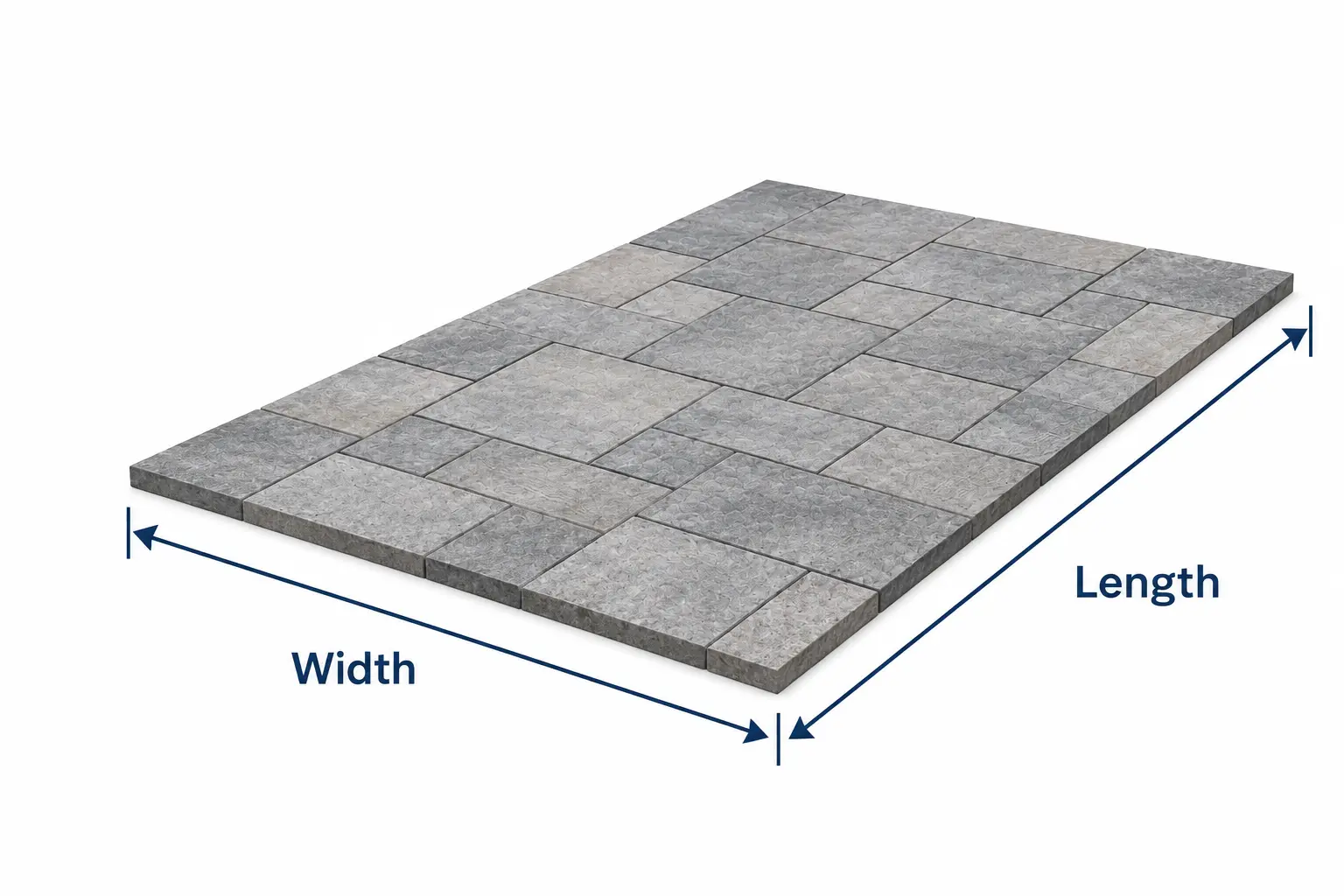
Calculate the square footage of a rectangular space using its length and width.
Related Calculators
How to Use This Calculator
- 1Measure the length of the space.
- 2Measure the width of the space.
- 3Enter both measurements into the calculator.
- 4Select the appropriate unit for each measurement.
- 5Click Calculate.
- 6Review the calculated area in square feet.
Common Uses
- Calculating room floor area
- Measuring wall area
- Estimating countertop surface area
- Planning tile or flooring coverage
- Measuring rectangular patios and outdoor areas
- General construction and home-improvement measurements
- Calculating area before a volume calculation
How to Calculate Square Footage
Square footage is the area of a surface measured in square feet. For a rectangular area, multiply the length by the width after converting both measurements to compatible units.
For example, a room that is 12 feet long and 10 feet wide has an area of 120 square feet.
The result is the geometric area of the dimensions entered.
Square Feet = Length × Width
Square Footage Formula
The basic formula for a rectangular area is length multiplied by width.
When both dimensions are measured in feet, multiply the length in feet by the width in feet to get square feet.
If measurements are provided in another supported unit, the calculator converts them as needed before determining the area in square feet.
Area = Length × Width
Calculating Square Feet From Feet and Inches
Measurements for rooms and home-improvement projects are often given in feet and inches.
Convert each measurement to a consistent unit before calculating the area.
For example, 12 feet 6 inches equals 12.5 feet. If the room is 10 feet wide, the calculation is 12.5 × 10 = 125 square feet.
When working with measurements that include inches, keep the conversion consistent for both dimensions.
12 feet 6 inches = 12.5 feet
How Much Square Footage Do I Need?
The square footage you need depends on the size of the area you are measuring. For a rectangular space, multiply its length by its width.
For example, a 15-foot by 20-foot area is 300 square feet.
The calculator provides the geometric area of the dimensions entered. If you are using the result to purchase a material such as flooring or tile, the amount of material required can differ from the measured area because product packaging, cuts, installation patterns, and project-specific allowances may affect purchasing quantities.
The Square Footage Calculator does not automatically calculate material quantities unless those outputs are implemented.
15 ft × 20 ft = 300 sq ft
Room Square Footage
A room with a rectangular floor can be measured by multiplying its length by its width.
For example, a room that is 14 feet long and 12 feet wide has an area of 168 square feet.
For a room that is not a simple rectangle, divide it into smaller rectangular sections where practical, calculate each section separately, and add the results.
Total Area = Area 1 + Area 2 + Area 3 + ...
Wall Square Footage
Square footage can also be used to describe the area of a rectangular wall.
Measure the wall's width and height, then multiply the two dimensions.
For example, a wall that is 12 feet wide and 8 feet high has 96 square feet of surface area before accounting for doors, windows, or other openings.
If a project contains several rectangular wall sections, calculate each section separately and add the results.
Wall Area = Width × Height
Tile Square Footage
Square footage is commonly used when planning the area covered by flooring or tile.
First determine the surface area by multiplying length × width. The resulting square footage represents the surface area to be covered.
Actual tile purchasing quantities can be different from the measured area because tile layouts, cuts, breakage, pattern requirements, and installation practices can affect the amount needed.
The calculator does not determine the number of tiles or boxes required unless that functionality is implemented.
Length × Width = Square Feet
Countertop Square Footage
For a rectangular countertop section, multiply its length by its width to determine the surface area.
For example, an 8-foot by 2-foot countertop section has an area of 16 square feet.
For countertops with multiple rectangular sections, calculate each section separately and add the results.
This provides the measured surface area; it does not automatically determine material purchasing quantities, seams, cutouts, or installation requirements.
Countertop Area = Length × Width
Square Feet vs. Linear Feet
Square feet and linear feet measure different things. Linear feet measure length, while square feet measure area.
A 10-foot-long board is 10 linear feet long, but its square-foot area depends on its width.
For a rectangular surface, multiply length by width to determine square feet.
This distinction is important when comparing measurements for lumber, flooring, countertops, walls, and other materials.
Square Feet = Length × Width
Square Feet vs. Cubic Feet
Square feet measure area, while cubic feet measure volume.
Square feet require two dimensions: length and width. Cubic feet require a third dimension such as depth or height.
For example, a 10-foot × 10-foot surface has 100 square feet. If that same area extends 2 feet deep, its volume is 200 cubic feet.
If you need a three-dimensional volume calculation, use the Cubic Feet Calculator.
Length × Width × Depth = Cubic Feet
Square Feet to Cubic Feet
Square footage alone cannot determine cubic feet because volume also requires a depth or height.
If you know the square footage and the depth, multiply the square footage by the depth in feet.
If the depth is measured in inches, multiply the square footage by the depth in inches and divide by 12.
For general three-dimensional calculations, use the Cubic Feet Calculator.
Cubic Feet = Square Feet × Depth in Feet
Square Feet to Cubic Yards
Square footage measures area, while cubic yards measure volume. You need a depth to convert an area into a volume.
When the area is known in square feet and the depth is measured in inches, multiply the square footage by the depth in inches and divide by 324.
For example, 1,000 square feet at 3 inches deep gives approximately 9.26 cubic yards.
For calculations specifically expressed in cubic yards, use the Cubic Yard Calculator.
Cubic Yards = Square Feet × Depth in Inches ÷ 324
Calculating Square Footage for Multiple Areas
If a project contains several separate rectangular areas, calculate each area individually and add the results.
For example, one area measuring 10 × 12 feet has 120 square feet, while another measuring 8 × 15 feet also has 120 square feet. Together they total 240 square feet.
This approach is useful when a project consists of several rectangular sections rather than one simple rectangle.
The current calculator should not be described as having a dedicated multi-area input unless that functionality is implemented.
Total Area = Area 1 + Area 2 + Area 3 + ...
Common Square Footage Calculation Mistakes
- Using inconsistent units: Make sure length and width use compatible units before calculating the area.
- Confusing square feet with linear feet: Linear feet measure length, while square feet measure area.
- Forgetting that area requires two dimensions: A single length measurement cannot determine square footage. Both length and width are required for a rectangular area.
- Using square footage as a volume measurement: Square feet measure area. A depth or height is required to calculate cubic feet or cubic yards.
- Forgetting separate rectangular sections: If a project contains multiple rectangular areas, calculate each section and add the results.
- Rounding measurements too early: Keep enough precision during the calculation and round the final area as appropriate.
- Treating area as an automatic material quantity: The measured square footage does not automatically determine how much flooring, tile, paint, or another material should be purchased.
Checking Your Square Footage Calculation
You can verify a rectangular calculation with simple multiplication.
Write down the length and width, make sure both measurements use compatible units, and multiply them together.
For example, a 16-foot by 12-foot area has 192 square feet.
If the calculator gives a substantially different result, check the entered dimensions and selected units.
16 ft × 12 ft = 192 sq ft
Square Footage for Common Projects
Square-foot measurements are useful for many types of projects, including rooms and floors, walls, countertops, tile and flooring areas, patios, rectangular outdoor areas, material coverage planning, and general construction measurements.
The square footage represents the area of the surface being measured. Any material-specific purchasing calculation may require additional information beyond the surface area.
Square Footage Calculation Quick Reference
| Calculation | Formula |
|---|---|
| Rectangular area | Length × Width |
| Square feet using feet | Length in Feet × Width in Feet |
| Multiple areas | Area 1 + Area 2 + Area 3 + ... |
| Square feet to cubic feet | Square Feet × Depth in Feet |
| Square feet + inches to cubic feet | Square Feet × Depth in Inches ÷ 12 |
| Square feet to cubic yards | Square Feet × Depth in Inches ÷ 324 |
Internal Calculator Resources
If you need to convert an area into three-dimensional volume, use the Cubic Feet Calculator.
For project volumes expressed in cubic yards, use the Cubic Yard Calculator.
For concrete-specific volume calculations, use the Concrete Calculator.
For gravel volume calculations based on project dimensions and depth, use the Gravel Calculator.
For mulch volume calculations, use the Mulch Calculator.
For soil volume calculations, use the Soil Calculator.