
Cubic Yard Calculator
Calculate project volume in cubic yards from length, width, and depth.
Related Calculators
How to Use This Calculator
- 1Enter the length of the area or space.
- 2Enter the width.
- 3Enter the depth or height.
- 4Select the appropriate unit for each measurement.
- 5Click Calculate.
- 6Review the calculated volume in cubic yards.
Common Uses
- Concrete volume
- Gravel volume
- Soil and dirt volume
- Mulch volume
- Landscaping materials
- Excavation and fill estimates
- Rectangular construction projects
- Converting cubic feet to cubic yards
What Is a Cubic Yard?
A cubic yard is a unit of volume. One cubic yard represents a space measuring 1 yard long, 1 yard wide, and 1 yard deep.
The key conversion is 1 cubic yard = 27 cubic feet. This makes cubic yards useful for describing larger quantities of materials that are commonly delivered or sold by volume.
For example, 54 cubic feet ÷ 27 = 2 cubic yards.
1 cubic yard = 27 cubic feet
How to Calculate Cubic Yards
For a rectangular project, first calculate the volume by multiplying the length, width, and depth.
If all three dimensions are measured in feet, the result is cubic feet. Divide the cubic-foot result by 27 to convert it to cubic yards.
For example, a project measuring 12 feet long, 10 feet wide, and 2 feet deep has a volume of 240 cubic feet. Dividing 240 by 27 gives approximately 8.89 cubic yards.
The result is the geometric volume of the space based on the dimensions entered.
Cubic Yards = Cubic Feet ÷ 27
Cubic Yard Calculator for Square Feet
If you already know the area in square feet, you can calculate cubic yards using the square footage and depth.
When the depth is measured in inches, multiply the square-foot area by the depth in inches and divide by 324.
The 324 comes from 12 × 27: 12 converts inches to feet and 27 converts cubic feet to cubic yards.
For example, an area of 1,000 square feet at 3 inches deep requires approximately 9.26 cubic yards.
This is the base volume before any separate purchasing allowance.
Cubic Yards = Square Feet × Depth in Inches ÷ 324
Cubic Feet to Cubic Yards
Converting cubic feet to cubic yards is straightforward. If you already know the volume in cubic feet, divide that value by 27.
You do not need to recalculate the project's dimensions when the cubic-foot volume is already known.
For example, 27 cubic feet equals 1 cubic yard, 54 cubic feet equals 2 cubic yards, and 81 cubic feet equals 3 cubic yards.
Cubic Yards = Cubic Feet ÷ 27
How Many Cubic Yards Do I Need?
The number of cubic yards you need depends on the size of the space and its depth.
For a rectangular area, multiply the length, width, and depth after expressing all three dimensions in feet, then divide by 27.
A larger area requires more cubic yards, while increasing the depth also increases the required volume. Doubling the depth while keeping the length and width unchanged doubles the calculated cubic-yard volume.
The calculator determines geometric volume. The actual amount of material to purchase may require a separate allowance depending on the material and project conditions.
Cubic Yards = Length × Width × Depth ÷ 27
Cubic Yard Calculator for Concrete
Concrete is commonly measured by volume, making cubic yards useful for larger concrete projects.
For a rectangular concrete project, multiply length × width × thickness when the dimensions are expressed in feet, then divide by 27.
For example, a slab measuring 20 feet × 10 feet × 0.5 feet contains 100 cubic feet, which equals approximately 3.70 cubic yards.
For calculations that specifically involve concrete quantities and the supported concrete-specific results, use the Concrete Calculator.
Cubic Yards = Length × Width × Thickness ÷ 27
Cubic Yard Calculator for Gravel
Gravel volume can also be expressed in cubic yards. For a rectangular gravel area, multiply the length, width, and depth in feet and divide the resulting cubic feet by 27.
The resulting volume describes the space occupied by the gravel.
Material type matters when converting volume into weight because different gravel products can have different densities. Do not automatically convert cubic yards to tons using a universal gravel density.
For a project specifically involving gravel volume, use the Gravel Calculator.
Cubic Yards = Length × Width × Depth ÷ 27
Cubic Yard Calculator for Soil and Dirt
Soil and dirt are also commonly measured by volume.
For a rectangular area, multiply the length, width, and depth in feet to calculate cubic feet, then divide by 27 to convert the result to cubic yards.
For example, an area measuring 15 feet × 10 feet × 1 foot contains 150 cubic feet, or approximately 5.56 cubic yards.
For a soil-specific calculation, you can also use the Soil Calculator.
The cubic-yard calculation determines volume. It does not determine soil weight, density, compaction, or the appropriate depth for a particular landscaping or construction project.
Cubic Yards = Length × Width × Depth ÷ 27
Cubic Yards and Material Purchasing
Cubic yards describe volume, not weight. A supplier may sell or deliver materials such as soil, gravel, mulch, or other bulk products by cubic yard.
The relationship between volume and weight depends on the material. Two materials occupying one cubic yard can have different weights because their densities differ.
Therefore, one cubic yard does not represent a universal weight. If a supplier provides material by weight rather than volume, use the supplier's stated density or product information to make the appropriate conversion.
1 cubic yard does not represent a universal weight
Measuring a Project for Cubic Yards
Good measurements are important because the calculated volume depends directly on the dimensions entered.
For a rectangular project, measure the length, width, and depth of the actual space whose volume you want to calculate.
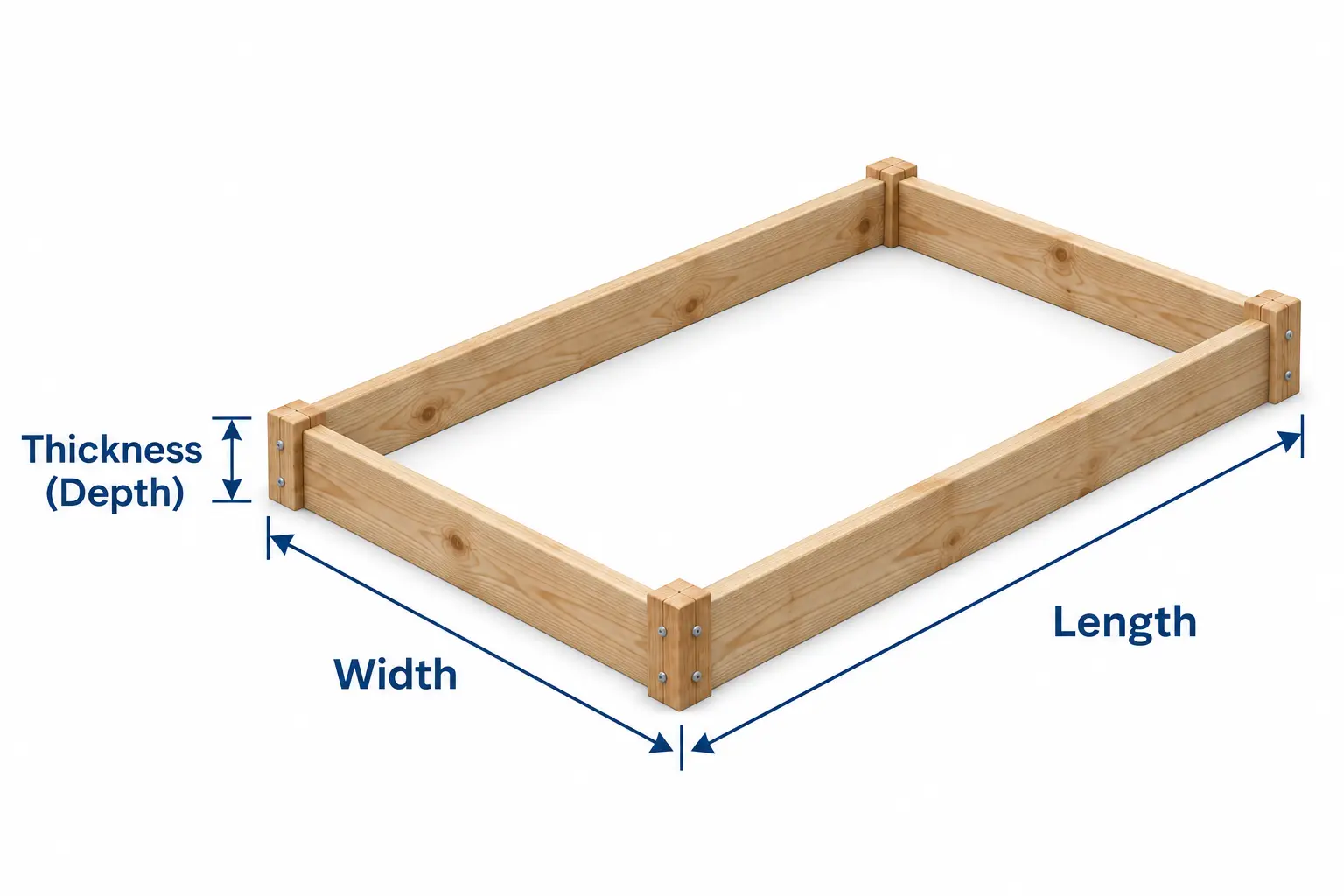
Length is the longest horizontal dimension, width is the dimension perpendicular to the length, and depth is the vertical distance from the top of the material or fill area to the bottom of the space being calculated.
If measurements use different units, use the calculator's unit selectors rather than manually mixing inches, feet, and yards without conversion.
- Length: Measure the longest horizontal dimension of the area.
- Width: Measure the dimension perpendicular to the length.
- Depth: Measure the vertical distance from the top of the material or fill area to the bottom of the space being calculated.
Irregular Areas
The basic cubic-yard calculation works directly for rectangular volumes.
If a project has an irregular shape, divide it into smaller measurable sections where practical. Calculate each section separately and add the volumes together.
For example, an L-shaped area can sometimes be divided into two rectangles.
Do not assume that the current calculator automatically accepts arbitrary irregular shapes unless that functionality is provided by its interface.
Total Volume = Volume 1 + Volume 2 + Volume 3
Cubic Yards for Different Project Materials
The cubic-yard conversion itself does not change based on the material. A cubic yard is a unit of volume whether the material is concrete, gravel, soil, dirt, mulch, or another bulk material.
What changes between materials are the purchasing units, density, packaging, and project-specific considerations.
The basic relationship remains volume in cubic feet converted to cubic yards. Use the material-specific CalConstruct calculators when you need additional calculations supported by those tools.
Volume → cubic feet → cubic yards
Common Cubic Yard Calculation Mistakes
- Forgetting the depth: Area alone gives square feet, not cubic yards. Volume requires a third dimension.
- Mixing inches and feet: If your depth is in inches while the length and width are in feet, convert the depth before multiplying.
- Forgetting the 27 cubic-foot conversion: One cubic yard equals 27 cubic feet. Divide cubic feet by 27 to convert the result to cubic yards.
- Confusing square yards with cubic yards: Square yards measure area, while cubic yards measure volume. A depth is required to convert an area into a volume.
- Assuming cubic yards equal a fixed weight: Material density varies, so do not treat cubic yards as tons or pounds without material-specific information.
- Rounding too early: Keep enough precision during the calculation and round the final result as appropriate for the project.
Checking a Cubic Yard Calculation Manually
You can verify a rectangular calculation independently by calculating the area, converting the depth, calculating cubic feet, and then converting cubic feet to cubic yards.
First multiply length × width to get square feet. Then divide the depth in inches by 12 to convert it to feet.
Multiply square feet by the depth in feet to get cubic feet. Finally, divide cubic feet by 27 to get cubic yards.
This gives you a simple way to check the calculator result independently.
Cubic Feet ÷ 27 = Cubic Yards
Cubic Yard Calculation Quick Reference
| Calculation | Formula |
|---|---|
| Rectangular volume | Length × Width × Depth |
| Cubic feet | Length × Width × Depth, using feet |
| Cubic yards | Cubic Feet ÷ 27 |
| Square feet + inches | Square Feet × Depth in Inches ÷ 324 |
| Cubic yards to cubic feet | Cubic Yards × 27 |
| Cubic feet to cubic yards | Cubic Feet ÷ 27 |
Internal Calculator Resources
Use the dedicated material calculators when you need a calculation specific to concrete, gravel, soil, or mulch. The Cubic Feet Calculator is useful when working directly with cubic-foot volume, while the Square Footage Calculator can help when you need to determine the area before applying a depth.